By Royce Pleiss | Published September 23, 2026 | Updated September 24, 2026
TL;DR
MERV 8 handles visible dust, and MERV 11 captures far more fine dust. MERV 13 catches at least half of the smallest particles tested, including most smoke. EPA favors MERV 13 when your system can handle it; a tune-up static pressure reading confirms that.
The best MERV rating for a 14.5x19x1 filter is the highest one your blower handles without strain. For pets, allergies, or smoke, that usually means MERV 11 or 13; when one return carries all the airflow, start at MERV 8. That is my answer after years of tune-ups.
Key Takeaways
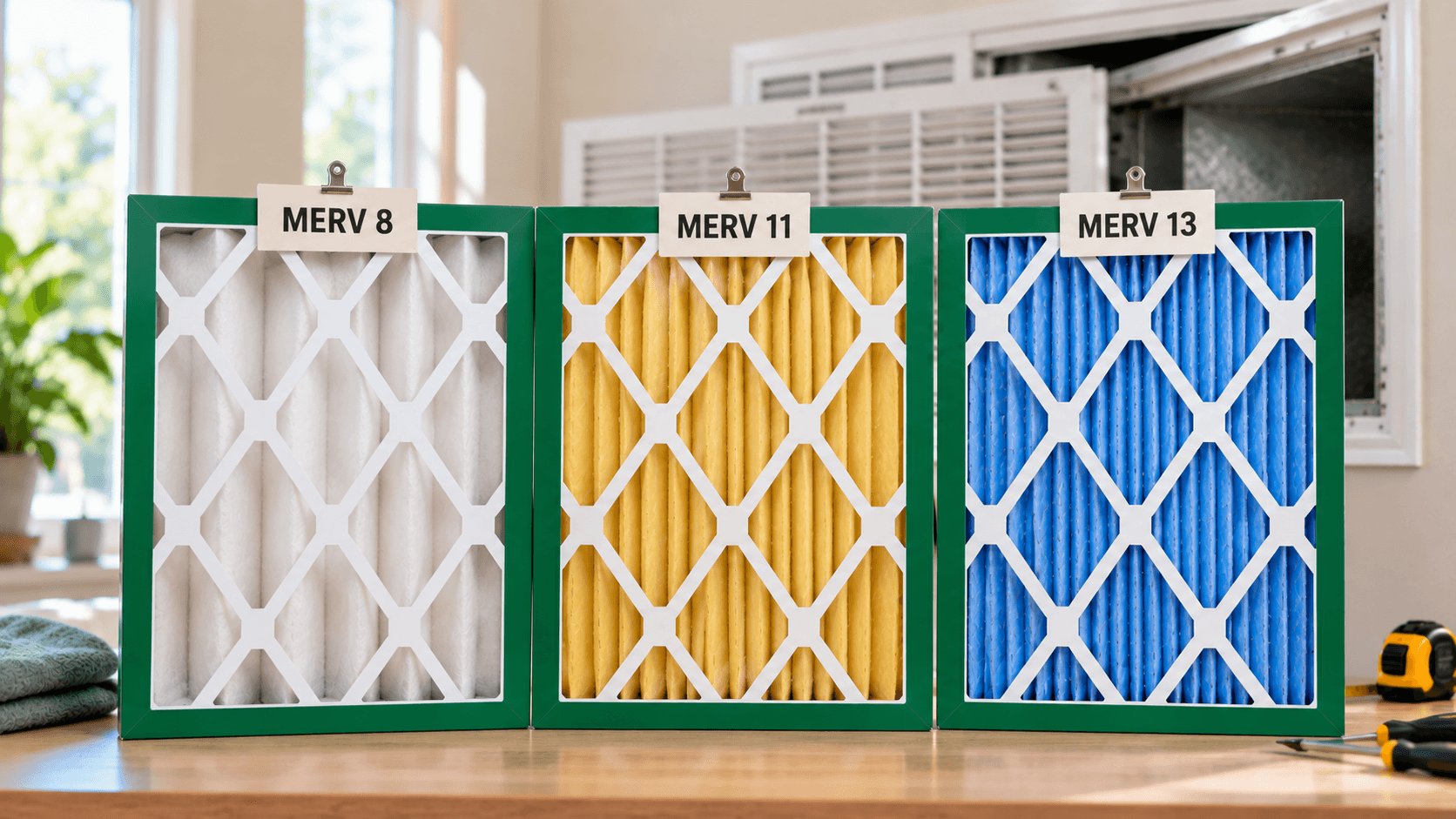
MERV 8 must capture at least 70% of 3 to 10 micron particles but only 20% of 1 to 3 micron particles.
MERV 11 raises 1 to 3 micron capture to at least 65% and starts filtering the 0.3 to 1 micron range.
MERV 13 captures at least 50% of 0.3 to 1 micron particles and at least 85% of 1 to 3 micron particles.
What Do MERV 8, 11, and 13 Capture in a 14.5x19x1 Filter?
MERV, short for Minimum Efficiency Reporting Value, rates how well an air filter captures particles between 0.3 and 10 microns under an ASHRAE test method. The EPA MERV rating table sets these minimums:
MERV 8: at least 70% of 3 to 10 micron particles and at least 20% of 1 to 3 micron particles. This covers lint, visible dust, pollen, and larger mold spores.
MERV 11: at least 85%, 65% and 20% across the large, middle and smallest ranges.
MERV 13: at least 90%, 85% and 50% across the same three ranges, adding most smoke and bacteria-sized particles.
The problem I find most in this size is fit, not rating. The U.S.-made pleated line I reference lists an actual 14.5 x 19 x 0.75 inches, and if the frame sits loose, air slips around the media and a MERV 13 performs like a much lower rating. These air filter installation tips cover sizing and airflow direction. Leaky return ducts cause the same bypass, which is where air duct repair comes in.
14.5x19x1 MERV 8 vs MERV 11: Which Handles Dust Better?
MERV 11 handles household dust better; it is my default. Both ratings trap visible dust and lint well, but MERV 11 must capture at least 65% of 1 to 3 micron particles, compared with 20% for MERV 8. That range is the fine dust that keeps resettling between cleanings.
MERV 8 still suits homes with no allergy sufferers or pets. Older PSC blower motors lose airflow as resistance rises, so a lighter filter is the cautious pick until the system is measured. Near end of life? Compare furnace and AC replacement costs before forcing a denser filter. See also upgrading filters for dust control during a tune-up.
Is MERV 13 Too High for a 1-Inch Filter?
Usually not. EPA notes in its consumer guide to air cleaners that most systems handle MERV 13 when it is replaced often. A 1-inch MERV 13 has less media depth, so undersized returns and weak blowers feel it first. Going higher rarely helps; here is why MERV 17 is not a furnace filter. EPA warns some ionizers emit ozone; vet any HVAC ionizer installation service.
What 14.5x19x1 MERV 13 Airflow Looks Like in Real Numbers
Before recommending MERV 13, I run the numbers. A 14.5 by 19 inch face is about 1.91 square feet. The Department of Energy's Building America guidance on high-MERV filters puts preferred face velocity at 200 to 400 feet per minute (FPM), with 500 as the ceiling. One 14.5x19x1 stays in range up to about 765 CFM and hits the ceiling near 955 CFM.
If a single 14.5x19x1 serves a system moving 1,000 CFM, air crosses it at roughly 520 FPM. Two or more returns split that load.
Thickness matters: in one MERV 7 line, the 1-inch version measured 0.20 inches of water column at 300 FPM versus 0.12 at 4 inches.
Read the Edge Label Before You Upgrade
Many pleated filters print MERV, particle-size efficiency and pressure drop on the frame; California has required it since 2019, per Building America. How I use it:
Find the drop at your airflow. One 1-inch MERV 13 there read 0.08 inches of water column at 410 CFM.
Compare it to the budget. Most homes run best at 0.4 to 0.5 inches total, so a filter at 0.25 spends half of a PSC blower's budget alone.
Skip unlabeled filters. Building America advises avoiding makers that will not publish pressure drop.
Watch the first week. A whistling return, a filter that bows or bangs at startup, weaker vents or ice on the indoor coil means step down one rating.
What Is the Best MERV Rating for a 14.5x19x1 Filter in Your Home?
MERV 11 suits most homes.
Choose MERV 8 if no one has allergies, asthma or pets, or your system already struggles to move air. A 14.5x19x1 MERV 8 filter is the baseline pick.
Choose MERV 11 if you have pets, seasonal allergies, or dust that returns quickly after cleaning.
Choose MERV 13 if wildfire smoke, asthma or heavy allergy seasons drive the decision and static pressure checks out.
To compare fairly, test one pleated line in all three ratings so only the media changes. 14.5x19x1 pleated air filters offered in MERV 8, MERV 11 and MERV 13 from a U.S. manufacturer share one 14.5 x 19 x 0.75 inch actual size, which makes a swap test between tune-ups simple.
How to Confirm Your MERV Choice at Your Next AC Tune-Up
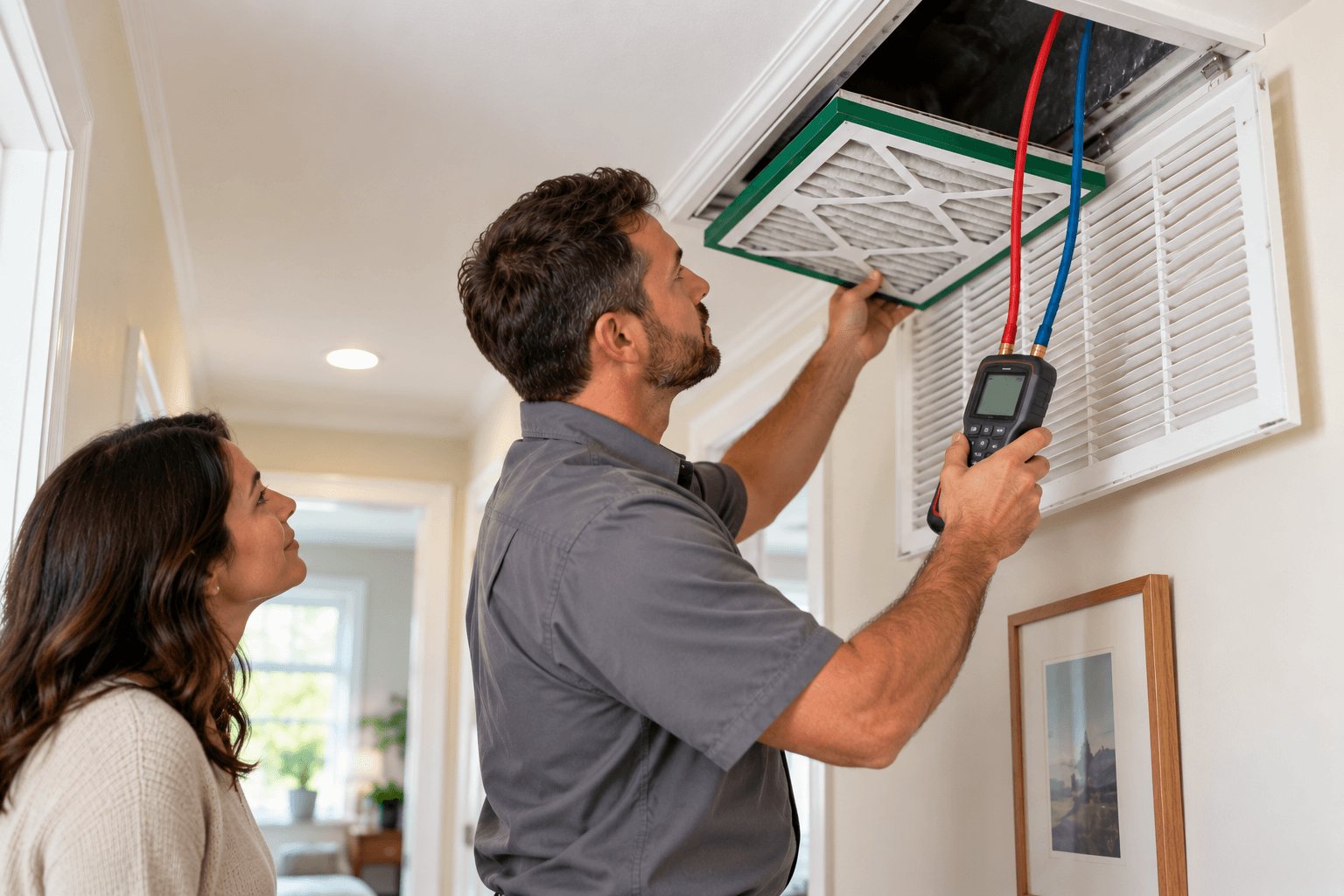
I test filter upgrades during regular professional tune-ups because the gauges are already connected; any HVAC maintenance company can do the same.
Install the new filter before the visit; here is how changing filters during an AC tune-up fits in.
Ask the technician to measure total external static pressure with the filter in place.
If readings run high, step down one MERV level or ask HVAC installation companies about adding return area.
Essential Resources: 7 Trusted Guides for Choosing and Maintaining a 14.5x19x1 Filter
Compare MERV 8, 11 and 13 in the Exact 14.5x19x1 Size
The 14.5x19x1 pleated filter page lists the actual size and all three MERV ratings.
Get a Snug, Leak-Free Fit in Your Filter Slot
The Department of Energy's Building America guide to furnace filter installation shows how to seat and seal a 1-inch filter.
Choose a MERV Rating Backed by Federal Guidance
EPA's Guide to Air Cleaners in the Home recommends MERV 13 or the highest rating your system accepts.
Check Whether Your System Can Handle MERV 13
ASHRAE's Filtration and Disinfection FAQ, from the society behind MERV, explains the tradeoff between capture and airflow resistance.
Set Realistic Expectations for Allergy Relief
An allergist answering the American Academy of Allergy, Asthma and Immunology Ask the Expert question on filtration favors efficient disposable filters and regular changes, noting limited clinical evidence.
Build a Filter Plan Before Wildfire Smoke Arrives
Washington State Department of Health smoke guidance recommends MERV 13 where the system allows it, plus spare filters and monthly checks.
Keep Your Filter and System on Schedule
ENERGY STAR's heating and cooling maintenance checklist covers monthly filter checks and tune-up tasks.
"In the 1-inch returns I check during tune-ups, a MERV 13 changed every 60 days usually reads lower on the manometer than a MERV 8 left in for six months." - Royce Pleiss, ac-tune-up.com
Supporting Statistics: What U.S. Research Shows
55%: Smoke Still Gets In
A Portland, Oregon home ran MERV 13 through 2020 wildfire smoke.
Indoor PM2.5 still averaged 55% of outdoor levels with the fan cycling on and off.
The model treated MERV 13 like MERV 10 once air bypass was counted.
Takeaway: seal the frame and run the fan longer, since wildfire smoke can linger after the fire is out.
Source: Antonopoulos, Dillon and Gall, Pollutants (2024), NIH PubMed Central
19%: AC Is the Biggest Electric Load at Home
AC used 19% of U.S. home electricity in 2020, more than any other use.
Takeaway: a clean filter protects your largest energy user.
Source: U.S. Energy Information Administration, Electricity Use in Homes
25.7%: One in Four Adults Has Seasonal Allergies
25.7% of U.S. adults had a diagnosed seasonal allergy in 2021.
Takeaway: this guide steers these homes toward MERV 11 or 13.
Source: CDC National Center for Health Statistics, Data Brief No. 460
Final Thought and Opinion: Start With the Slot, Not the Number
Fit and change schedule matter as much as the rating.
My take: Most 14.5x19x1 decisions get made backward.
Homeowners pick a MERV number first and check the slot last.
At the tune-ups I do, a snug MERV 11 changed on schedule beats a loose MERV 13 left in too long. The Portland data agrees.
The right order:
Measure the slot.
Get a static pressure reading.
Pick the highest rating your system handles, ideally from one line sold in all three.
Next Steps: Your 14.5x19x1 Action Plan
Check your filter. Read the size and MERV rating on the frame, and note whether it is reusable or disposable.
Pick a rating. Choose MERV 8, 11 or 13 from the same U.S.-made 14.5x19x1 line so fit stays constant.
Install it right. Point the arrow toward the blower. Confirm a snug fit.
Test it at your tune-up. Ask for a static pressure reading. Prep with these tips for preparing for an AC tune-up.
Stay on schedule. Keep a spare. Replace every 60 to 90 days, sooner with pets or smoke.
Frequently Asked Questions
Can I Switch From MERV 8 to MERV 13 in the Same 14.5x19x1 Slot?
Yes, the filter fits; the question is airflow. Step up to MERV 11 first, or confirm MERV 13 with a static pressure reading.
How Often Should I Change a 14.5x19x1 MERV 13 Filter?
Replace it every 60 to 90 days, the range EPA cites; ENERGY STAR advises checking your HVAC filter every month. Pets or wildfire smoke push that closer to 60 days.
Does a Higher MERV Rating Raise My Energy Bill?
It can on an undersized system. ECM blowers draw more power and PSC blowers lose airflow, and restriction shortens blower motor life; a clean MERV 13 often costs less than an overdue filter.
Is 14.5x19x1 the Same as 14 1/2 x 19 x 1?
Yes. Both name the same nominal size, and the pleated line cited above lists 14.5 x 19 x 0.75 actual. Other sizes work the same way, as this guide to 19x19x1 air filters shows. The mix-ups I see most are near-miss sizes that will not fit:
Wider: a 15x19x1 is half an inch wider.
Different frame: 14x20x1 filters, sold as a MERV 8 four-pack or an odor-control two-pack, measure 13.5 x 19.5 actual.
Other frames: MERV 13 14x22x1, odor-eliminating 12x24x1 and a thicker MERV 8 14x36x2 will not fit; this 20x30x2 actual vs. nominal guide shows how labels mislead.
Elsewhere: check actual dimensions on any online marketplace listing or the French-language Canadian store.
Choose the MERV Rating That Fits Your 14.5x19x1 Filter and Your Home
Pick the rating that fits your household and your slot. Then confirm it at your next tune-up.
Glossary
MERV (Minimum Efficiency Reporting Value): A 1 to 16 scale defined in ASHRAE Standard 52.2 that reports the minimum share of 0.3 to 10 micron particles a filter captures.
Static pressure: Resistance to airflow inside the duct system, measured in inches of water column with a manometer.
14.5x19x1 pleated filter: A 1-inch nominal HVAC filter measuring 14.5 x 19 x 0.75 inches actual, made in the USA in MERV 8, 11 and 13.
Learn more about HVAC Care from one of our HVAC solutions branches…
Filterbuy HVAC Solutions - Miami FL - Air Conditioning Service
1300 S Miami Ave Apt 4806 Miami FL 33130
(305) 306-5027
https://maps.app.goo.gl/Ci1vrL596LhvXKU79